Our research focuses on computational mechanics, fracture and damage mechanics, peridynamics and related nonlocal models, composite structures, and physics-informed artificial intelligence, with applications in aerospace, defense, energy, and biomedical engineering.
Structural Health MonitoringPeridynamics & FracturePDDOAdditive ManufacturingBiomechanicsComposites & RZTPhysics-Informed ML
FEATURED RESEARCH
Structural Health Monitoring and Digital Twins
Structural health monitoring and digital twin applications require the full strain and displacement fields of a structure, while only a limited number of sensors can be installed in practice. Using the peridynamic differential operator (PDDO), we reconstruct the full strain and displacement fields from sparse sensor data, enabling real-time monitoring of aerospace structures.
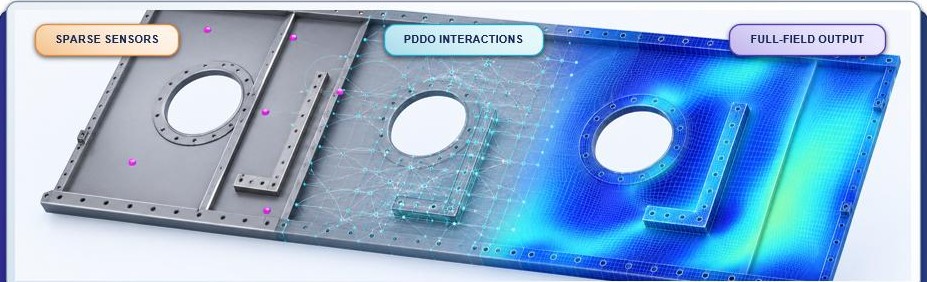
Sparse sensor measurements → PDDO interactions → full-field output.
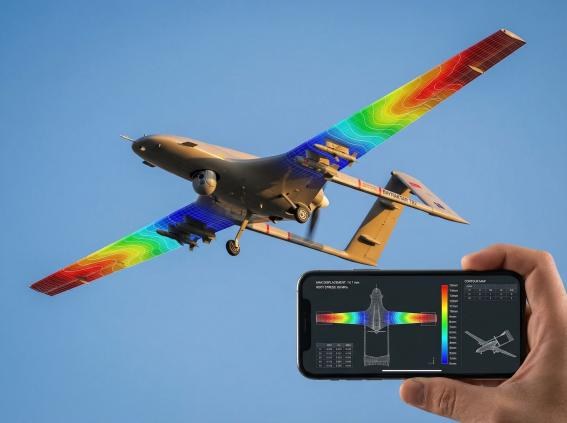
Digital twin concept: real-time full-field monitoring of a UAV.
- Sparse sensors: measurements at a limited number of locations.
- PDDO interactions: the peridynamic differential operator links the sensor data to the entire structure.
- Full-field output: strain and displacement fields over the whole structure.
- Digital twin: real-time visualization and assessment of the structural response.
Peridynamic Theory for Fracture and Damage
Peridynamics is a nonlocal continuum theory based on integral equations, so crack initiation, propagation, branching, and multiple cracks are captured without external failure criteria or remeshing. Our recent work includes dual-horizon bond-based peridynamic models with PDDO-based elastoplastic correction for ductile fracture, fatigue analysis of ductile materials with Neuber’s plasticity correction, and the effect of stop holes on fatigue crack growth in aerospace structures.
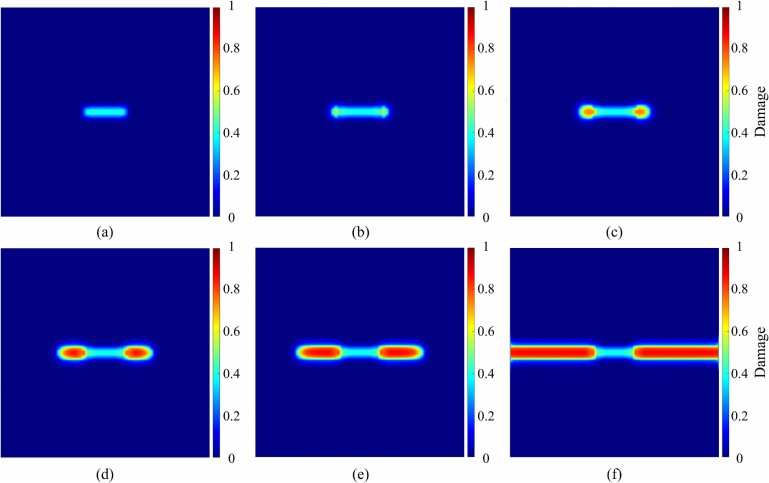
Damage evolution in a center-cracked plate under tension (Computers & Structures, 333, 108494, 2026).
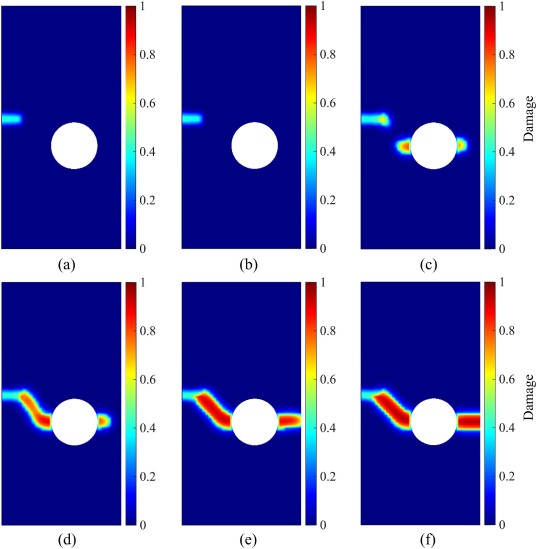
Predicted crack path for an edge crack interacting with a circular hole.

Peridynamic Differential Operator (PDDO)
The PDDO enables the nonlocal form of local differentiation and is used for:
- analysis of discrete data such as interpolation, regression, recovery, and smoothing;
- solution of linear and nonlinear partial differential equations of parabolic, hyperbolic, and elliptic types with and without a discontinuity in the form of an interface or a crack;
- reconstruction of full-field response from sparse sensor data for structural health monitoring.


Image recovery with the PDDO.

PDDO predictions for crack propagation from an inclined pre-existing crack.

(a) The horizontal and (b) vertical displacement variations of a diagonal plate with a pre-existing crack under displacement constraints.

Size Effects and Damage in Additively Manufactured Thin-Walled Structures
Within the TÜBA-GEBİP project, we are developing a multiscale numerical model that, for the first time, combines peridynamics with strain gradient elasticity and plasticity to account for the intrinsic length scales of the material. Microstructure, size effect, and crack propagation are described within a single physical framework, and the model will be validated by µCT and multiaxial tests on L-PBF Ti6Al4V and Haynes-282 specimens with different wall thicknesses.
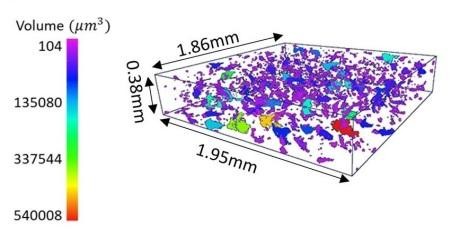
µCT pore distribution in an additively manufactured Ti6Al4V specimen.
Computational Biomechanics
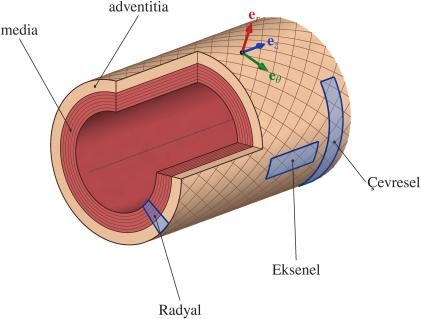
Layered artery model (media and adventitia).

In our TÜBİTAK 1001 project, vessel geometry and tissue properties are obtained from intravascular ultrasound (IVUS) images and used in image-based peridynamic models supported by artificial neural networks to predict possible damage in vascular structures during angioplasty.
Composite Structures and Refined Zigzag Theory
Finite element and peridynamic formulations based on refined zigzag theory and higher-order shear deformation theories for the stress, vibration, and failure analysis of laminated and sandwich composite beams, plates, and shells.
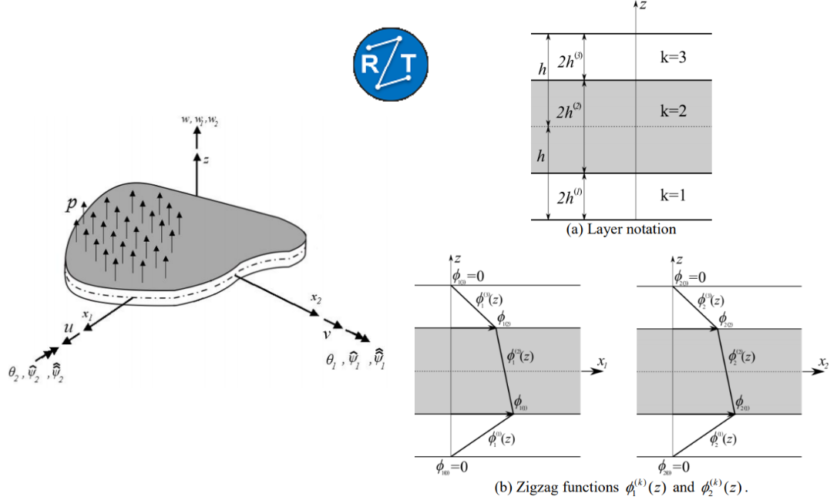
Refined zigzag theory: layer notation and zigzag functions of a laminated plate.
Physics-Informed Neural Networks
Physics-informed machine learning for the modeling of laminated composite structures and the solution of differential equations.
